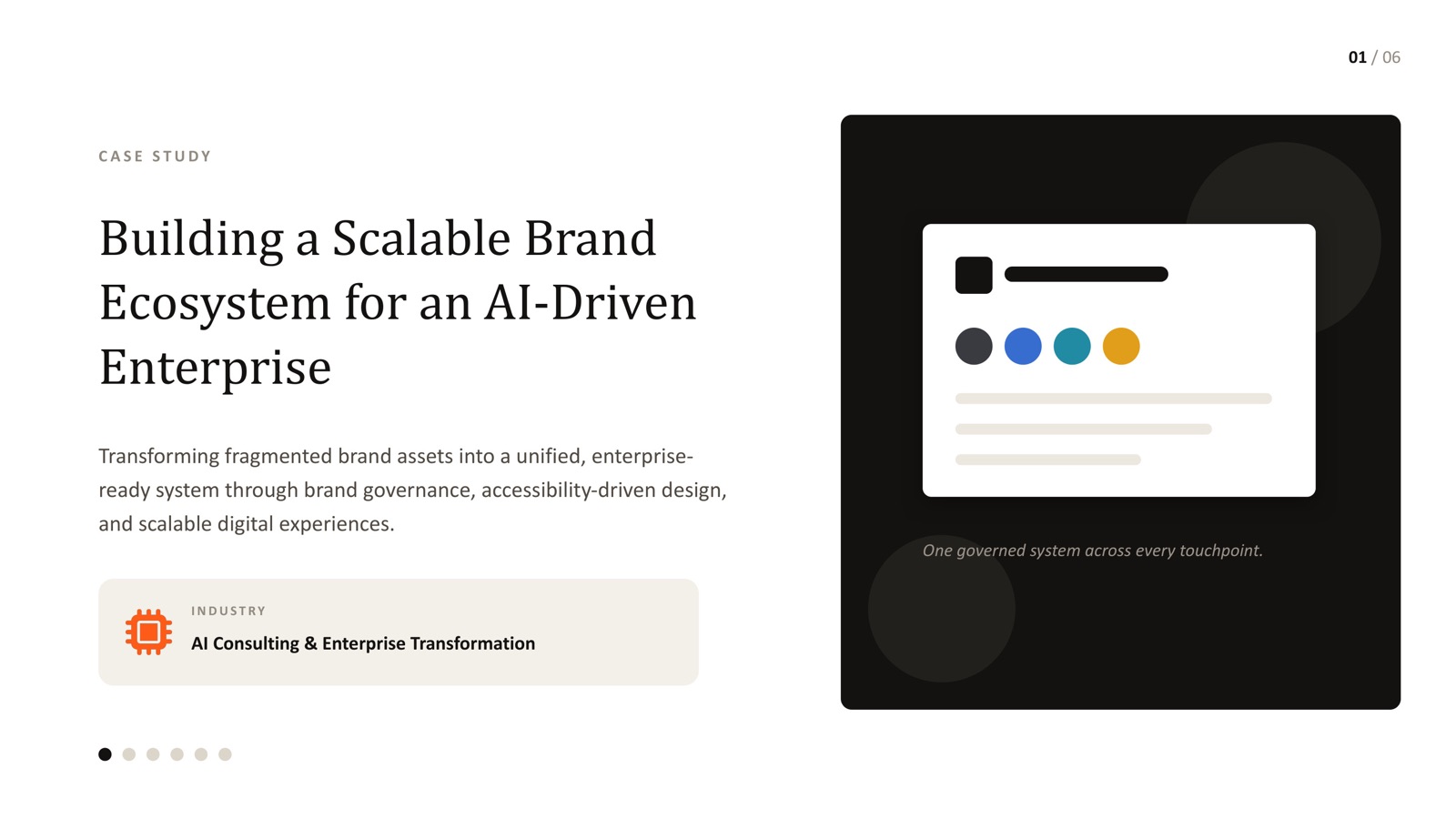
- Fast-shipping AI companies usually have brand assets, not a brand system - the difference is governance.
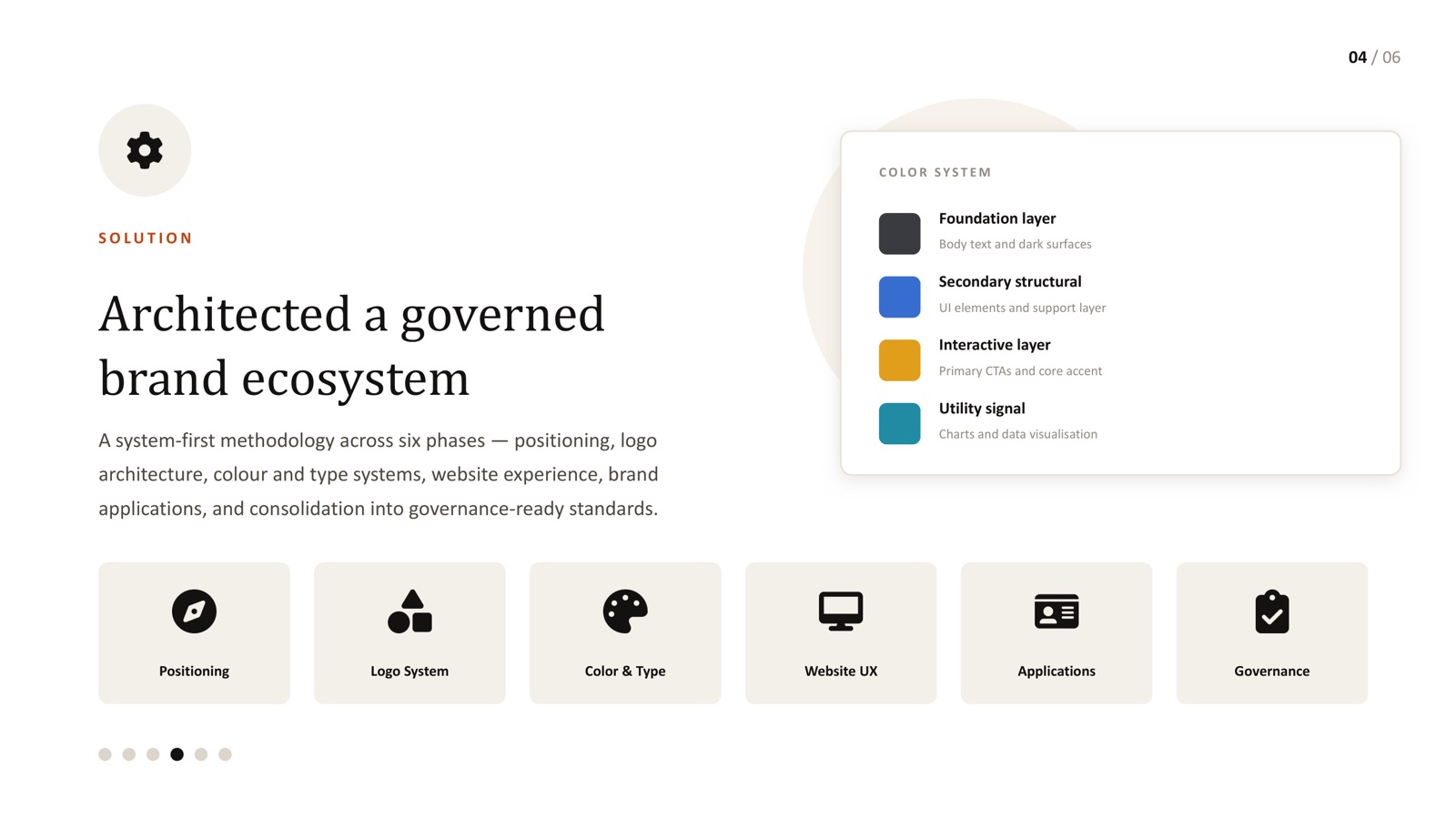
- A six-phase approach works well: positioning, logo system, colour & type, website UX, applications, governance.
- Governance documentation is what actually stops the brand fragmenting as more teams ship independently.
- Accessibility should be tested into the colour system, not assumed - see the real contrast numbers in our WCAG contrast case study.
- Full build documented in our AI enterprise brand ecosystem case study.
Most AI companies don't have a brand problem in the way that phrase usually implies. They have logo assets, a rough colour palette, maybe a style guide someone put together during a fundraising push. What they don't have is a system - a documented, governed reference that a team of 20 or 200 people can actually build from without reinventing brand decisions every sprint.
That gap becomes expensive fast. Every new landing page, every feature launch, every marketing asset becomes an independent brand decision, made by whoever happens to be building it - and the product starts to look like it came from several different companies.
Six phases, not one big brand refresh
A brand system for a fast-moving AI company works best built in stages, each with a clear deliverable rather than one undifferentiated "rebrand" project:
- Positioning - what the brand needs to communicate before any visual work starts
- Logo system - replacing inconsistent variations with one governed system and clear usage rules
- Colour & type - a layered system tested for accessibility, not assumed to be compliant
- Website UX - applying the system to real product and marketing surfaces, not just a brand deck
- Applications - extending the system across every touchpoint the brand actually shows up on
- Governance - documented rules a distributed team can apply without a design bottleneck
The sequencing matters. Skipping straight to visual identity without positioning produces a brand that looks nice and says nothing specific. Skipping governance at the end means the system decays back into fragmentation within a few quarters.
Governance is the phase most teams skip
It's also the phase that determines whether the previous five hold up. Governance documentation - who can use the logo where, what the colour system's rules are, how new applications should be evaluated against the system - is what lets a distributed team ship consistently without routing every decision through a design bottleneck. Without it, brand consistency depends entirely on tribal knowledge, which erodes the moment the original team members move on or the company scales past the size where everyone remembers the rules.
The AI companies I've worked with almost never lack good instincts about their brand - what tends to be missing is the system that lets those instincts scale past the founding team. Everyone agrees the brand should feel a certain way; nobody has written down specifically what that means for a button colour or a logo minimum size.
On a recent AI enterprise brand ecosystem project, transforming fragmented assets into a genuinely governed system didn't slow the team down - it removed a recurring source of friction, because designers and engineers stopped having to guess or ask. That's the real test of whether a brand system is working: does it make decisions faster, not slower.
Where this applies
If your team is shipping fast enough that brand consistency keeps slipping, the fix usually isn't slowing down - it's building the governed system that lets speed and consistency coexist. This is the exact path covered in our AI enterprise brand ecosystem case study. It's especially relevant for teams based in Bangalore, India's densest concentration of funded SaaS and AI product companies, where this kind of brand fragmentation shows up earliest.
Brand fragmenting as your team ships faster?
Let's talk about what a governed brand system would look like for your product.