Long library corridor lined with bookshelves
Home / Design Systems & Accessibility / Documentation & governance
Design Systems & Accessibility · Documentation & governance

Documentation and governance: what keeps a design system alive

A design system without documentation is a component library, and one without governance slowly drifts apart. I set up both, so your system stays trusted, current and used as teams grow.

Usage documentationOwnershipContribution modelRelease & deprecationHealth metrics

Why systems drift

Design systems rarely fail because of bad components. They fail because people don't know when to use them, can't find answers quickly, can't get new needs met, or don't trust that the system is current. So they detach components, hard-code values, and copy an old screen instead. Each workaround is reasonable. Together they rebuild the inconsistency the system was created to remove.

Documentation and governance are the fix. Documentation answers "how and when do I use this?". Governance answers "who decides, how does it change, and how do I get what I need?". Get both right and the system becomes the fastest way to build, which is the only thing that guarantees adoption.

Is this you?

Signs you need documentation and governance

01

Detached components

Designers break components to make local changes.

02

"Is this still current?"

Nobody is sure which version of a pattern is correct.

03

Requests go nowhere

Teams need new components and build their own when nobody responds.

04

One person is the system

Every question goes to the same designer or engineer.

05

Docs show visuals only

Pages show what a component looks like but not when to use it.

06

Old patterns never die

Deprecated components remain in production indefinitely.

Documentation that answers real questions

Good documentation is written for someone in the middle of building something. For each component and pattern it covers:

SectionAnswers
When to useWhich problem this solves - and what to use instead in similar situations
Anatomy and variantsWhat the parts are and which variants exist
States and behaviourHow it behaves in every state, on every device
ContentLabel length, tone, error and status wording
AccessibilityKeyboard behaviour, focus, screen-reader output, contrast values
Do and don'tReal examples from your product, including common mistakes
CodeComponent name, props and token references for engineers
ChangelogWhat changed, when and why

Rules should be specific enough to settle a disagreement. "Use primary buttons sparingly" is advice; "one primary button per view" is a rule. The same principle drove the infrastructure brand system's measurable specifications - see enforceable design systems vs style guides.

Governance: five decisions to make

Ownership. A named person or small team maintains the system and approves changes. In smaller companies, often one designer and one front-end engineer with protected time.

Contribution. A lightweight route for teams to propose new components or changes: check the system, propose with a use case and draft, review, build, document, release.

Release and versioning. Regular, small releases with a changelog and clear migration notes for breaking changes.

Deprecation. Old patterns marked deprecated with a replacement and removal date, and usage tracked until it reaches zero.

Exceptions. A way to approve justified one-offs with a reason and an expiry date - and a review of repeated exceptions, which usually signal a missing component.

Governance that speeds teams up

The goal of governance is fewer decisions, not more approvals. Anything built from existing components, tokens and patterns should ship without extra review; only genuinely new patterns go through the contribution process. When governance works, it measurably speeds delivery - Figma found designers completed a task 34% faster with a design system - because people stop re-deciding solved problems.

Health metrics

MetricWhat it tells you
Component coverage in productionHow much of the product actually uses the system
Detached or overridden instancesWhere the system isn't meeting needs
Hard-coded values in codeWhere tokens are being bypassed
Contribution requests and response timeWhether the system responds to teams
Accessibility defects from custom UIWhere bypassing the system creates risk
Time to build a standard screenWhether the system is delivering speed

Reviewed monthly, these numbers show where to invest next - and give leadership a reason to keep funding the system.

The process

How I set up documentation and governance

  1. 01

    Assess

    Current documentation, adoption, workarounds and where teams get stuck.

  2. 02

    Decide the model

    Ownership, contribution, release and deprecation processes that fit your organisation.

  3. 03

    Write the docs

    Starting with the most-used components and patterns.

  4. 04

    Set up the site

    Documentation where teams already work - a doc site, Figma, or both.

  5. 05

    Define metrics

    A small set of health metrics and a review cadence.

  6. 06

    Launch and coach

    Sessions for design and engineering, and support for the first contribution cycles.

What you get

01

Documentation

Usage, behaviour, content and accessibility guidance for core components and patterns.

02

Governance charter

Ownership, decision rights, contribution and exception processes.

03

Release process

Versioning, changelog template and migration guidance.

04

Deprecation policy

How patterns retire, with tracking.

05

Health dashboard

Metrics definitions and a review cadence.

06

Team onboarding

Training for designers and engineers.

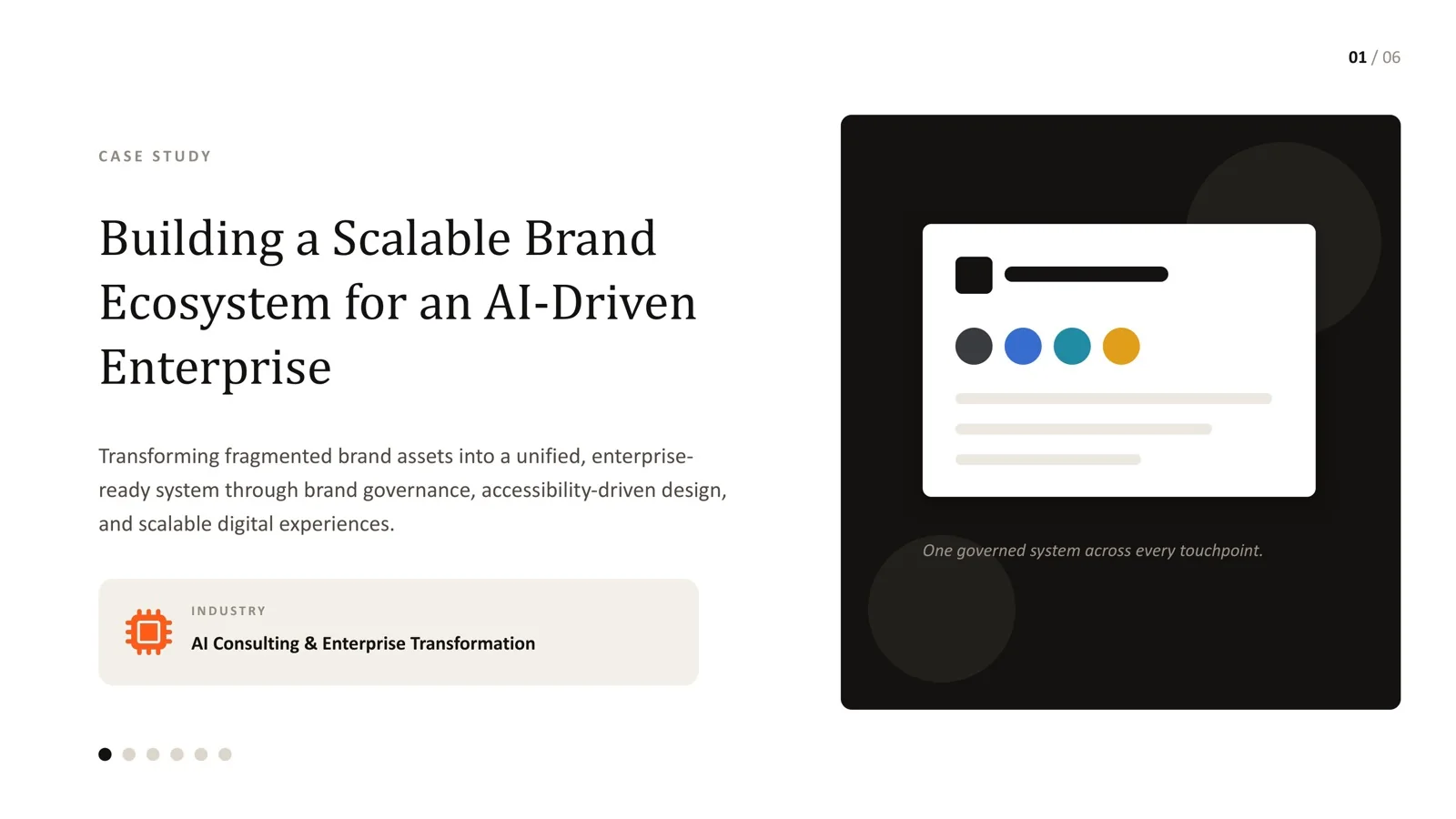
Governance phase of the AI enterprise brand ecosystem
From the work

Governance a distributed team could apply without a bottleneck

The final phase of an AI enterprise brand ecosystem was governance - documented rules a distributed team could apply without waiting on design review for every new page or feature.

  • A componentised system with clear usage rules.
  • Every colour pairing tested against WCAG 2.1 before it ships.
  • One logo system with clear usage rules, replacing several variants.
Read the AI brand case study →

Frequently asked questions

Where should design system documentation live?

Where teams already work. Many teams use a documentation site for guidance plus Figma libraries and code comments for detail. The key is one clear source of truth.

How do we get teams to contribute rather than build their own?

Make contributing faster than working around the system: a short proposal template, a quick response, and visible credit when contributions ship.

How often should we release updates?

Small, frequent releases - every sprint or two - with a changelog. Large, infrequent releases make migration harder.

What if leadership won't fund a design system team?

Start with part-time ownership and show value with metrics: faster delivery, fewer defects, higher adoption. Those numbers make the case for more investment.

Do we need governance if we're a small team?

Yes, but lighter. Even two designers benefit from agreed ownership, a changelog and a simple rule for adding new patterns.

Sources

Every statistic in this page links to its original publisher. Figures were checked against these sources on September 29, 2026.

  1. Measuring the value of design systems - Figma
Let's solve something

Design system drifting despite everyone's best efforts?

Let's put the documentation and governance in place that stop it. Book a 30-minute call.

Book a 30-min call ↗