
Owners, managing directors and marketing leads at established B2B trade, distribution and equipment companies whose reputation offline is stronger than their brand online.
- Many established B2B trade and equipment companies have earned real trust through reliable products and service - and have a digital brand that undersells all of it.
- New buyers increasingly judge you online before they talk to anyone. Visual design is the most cited factor when people judge a website's credibility.
- The identity's job is to make the brand feel as credible as the products it sells: restraint over decoration, clarity over cleverness, consistency everywhere.
- Brand and UX need to be solved together. A new logo on a confusing site does not fix the buyer's experience.
- Most of the credibility gap is closed by consistency across the real buyer journey - especially product and comparison pages - rather than a bolder rebrand.
There is a particular kind of B2B company that has earned trust through decades of reliable products and dependable service, and a website that undersells all of it. The identity was created once, years ago, and the digital presence has drifted further from the company's actual standing every year since. Existing customers know how good the company is. New buyers researching online see a dated site that quietly raises doubt.
This article explains why that gap costs real business, where it usually hides, and how to close it without throwing away the equity the company already has.
Why the offline reputation stops at the website
B2B buying has moved online at the research stage. Forrester found that a typical buying decision involves 13 internal stakeholders and nine external influencers - many of whom will never meet your sales team, but will look at your website, product pages and documents. The first impression they form is visual and fast. Researchers found people can judge a page's visual appeal in about 50 milliseconds, and Stanford's large credibility study found a site's "design look" was the most frequently mentioned credibility factor, cited in 46.1% of comments.
Trust is also central to the purchase itself. In Edelman's research, 81% of people said they must be able to trust a brand to do what is right as a deciding factor in buying. Established trade companies usually have that trust with their customers - the brand problem is that newcomers cannot see it.
Where the credibility gap usually hides
When I review trade and equipment brands, the gap is rarely in one dramatic place. It leaks across touchpoints:
| Touchpoint | Common issue | What closes the gap |
|---|---|---|
| Homepage | Generic claims ("quality products, great service") that any competitor could make | Specific proof: years in business, brands carried, installations, service coverage, certifications |
| Product pages | Supplier photos of varying quality, thin descriptions, missing specifications | Consistent photography, complete specifications, clear availability and support information |
| Comparison and category pages | Inconsistent layouts that make comparing difficult | One template, the same attributes in the same order for every product |
| Catalogues and price lists | PDF files designed years apart in different styles | A document template aligned with the new identity |
| Sales decks and proposals | Every rep's personal version | A shared, easy-to-use presentation template |
| Vehicles, uniforms, showroom | Old logo versions still in use | A rollout plan and asset audit |
Notice that most fixes are about consistency and completeness, not a new logo.
What the identity actually needs to communicate
For a trade or equipment company, the identity's job is not to look impressive in the abstract. It is to make the brand feel as credible as the products it sells, to the specific buyers evaluating it. In practice that usually means:
- Restraint over decoration. A clear palette with one confident accent, used consistently, reads as established. A rainbow of colours reads as improvised.
- Clarity over cleverness. Headlines that say what you do and for whom beat wordplay that makes buyers work.
- Real over staged. Photographs of real installations, warehouses, service teams and customers beat generic stock imagery.
- Evidence over adjectives. Numbers and specifics - range, response times, brands, certifications - carry more weight than "leading" and "premium".
Brand and UX have to be solved together
It is tempting to run a brand refresh and a website redesign as separate projects with separate timelines and agencies. For trade and equipment companies, that split usually produces a worse result than either alone. A beautiful new identity applied to a confusing navigation does not fix the buyer's experience, and a UX fix without brand work leaves the credibility gap in place.
On a B2B hospitality equipment platform, the redesign combined both: positioning and visual identity work so the brand felt as credible as the products, alongside rebuilding navigation, journeys and product presentation around three real buyer types. Read more about that side of the work in persona-led UX for B2B buyers and auditing a B2B equipment website before a redesign.
A practical approach that protects existing equity
- Audit what you have. Gather every live touchpoint - website, catalogues, decks, email templates, vehicles, packaging - and note inconsistencies. Most companies are surprised by how many logo versions are in use.
- Talk to customers and sales. Ask long-standing customers why they chose and stayed with you. Their answers are your positioning raw material.
- Decide what to keep. Recognisable elements - a colour, a symbol, a name - carry equity. Refresh rather than replace unless there is a strong reason.
- Define positioning in writing. Who you serve, what you are best at, and the proof. See our notes on positioning.
- Build the system. Logo rules, colour roles, typography, photography direction, and templates for the documents buyers actually receive.
- Apply it where decisions happen. Product pages, category pages and quote flows first; campaign materials later.
- Govern it. One owner, one asset library, and a simple way for sales and marketing to get what they need.
How to tell if you have a credibility gap
- New prospects are surprised by your scale or capability once they talk to you.
- Sales reps avoid sending people to the website.
- Your largest customers have been with you for years, but online enquiries are low-quality or rare.
- Competitors with less experience look more established online.
- Your team maintains their own versions of the catalogue or deck.
If several of these apply, the problem is not your products. It is how you are presenting them.
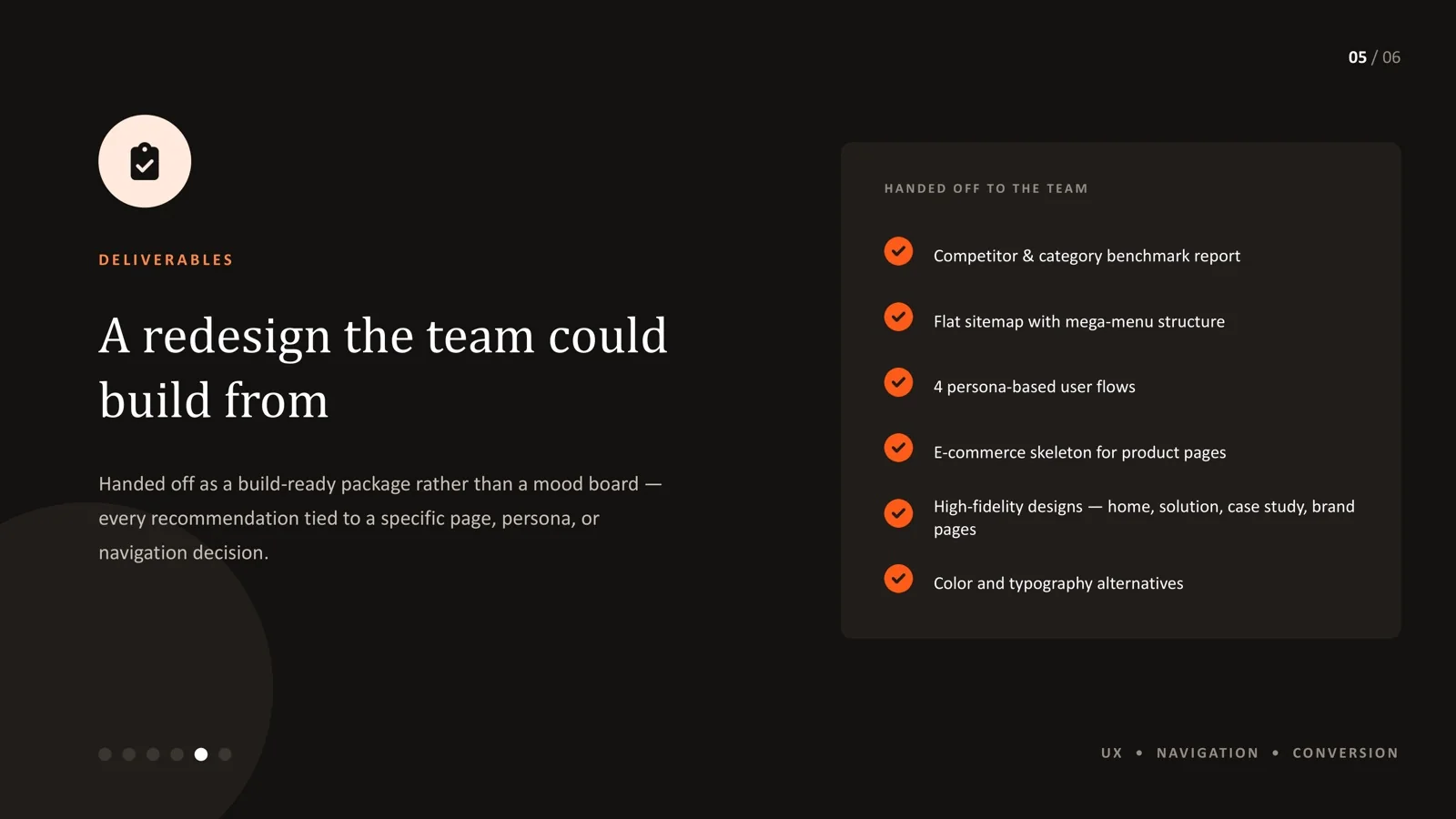
The B2B companies I have worked with in this space rarely need a bolder brand. They need a more consistent one. The identity is usually fine in isolation; what is missing is application discipline across the real buyer journey, especially on the product and comparison pages where decisions actually get made.
Positioning and visual identity tied to how the site's UX and navigation work - not treated as a separate marketing exercise - is what closes the gap between a company's real-world reputation and its digital first impression. That gap is usually smaller to fix than owners fear, once brand and UX are approached as one project.
Frequently asked questions
Do we need a new logo?
Often not. If the existing mark is recognised by customers, refreshing and systematising it usually preserves more value than replacing it. Replace it only if it no longer reflects the business or has practical problems at small sizes.
How do we present thousands of products consistently?
Use a single product-page template with the same attributes in the same order, a photography standard for new images, and a plan to upgrade the highest-traffic products first. See our guide to design systems at catalog scale.
Should a trade company talk about brand values?
Only if they are backed by evidence buyers care about - delivery reliability, service coverage, technical support. Values without proof read as filler.
What should we fix first on the website?
Product and category pages, because that is where comparison and purchase decisions happen, followed by the homepage's proof points.
How do we get sales teams to use new materials?
Involve them early, make the templates quicker to use than their own versions, and remove old files from shared drives.
Brand not matching your company's real credibility?
Let's close the gap between your reputation and your digital presence.
Sources
Every statistic in this article links to its original publisher. Figures were checked against these sources on September 29, 2026.
- The State Of Business Buying, 2026 - Forrester, 2026
- Attention web designers: You have 50 milliseconds to make a good first impression! - Lindgaard et al., Behaviour & Information Technology, 2006
- How Do People Evaluate a Web Site's Credibility? - Fogg et al., Stanford / Consumer WebWatch, 2002
- In Brands We Trust? - Edelman Trust Barometer Special Report, 2019