
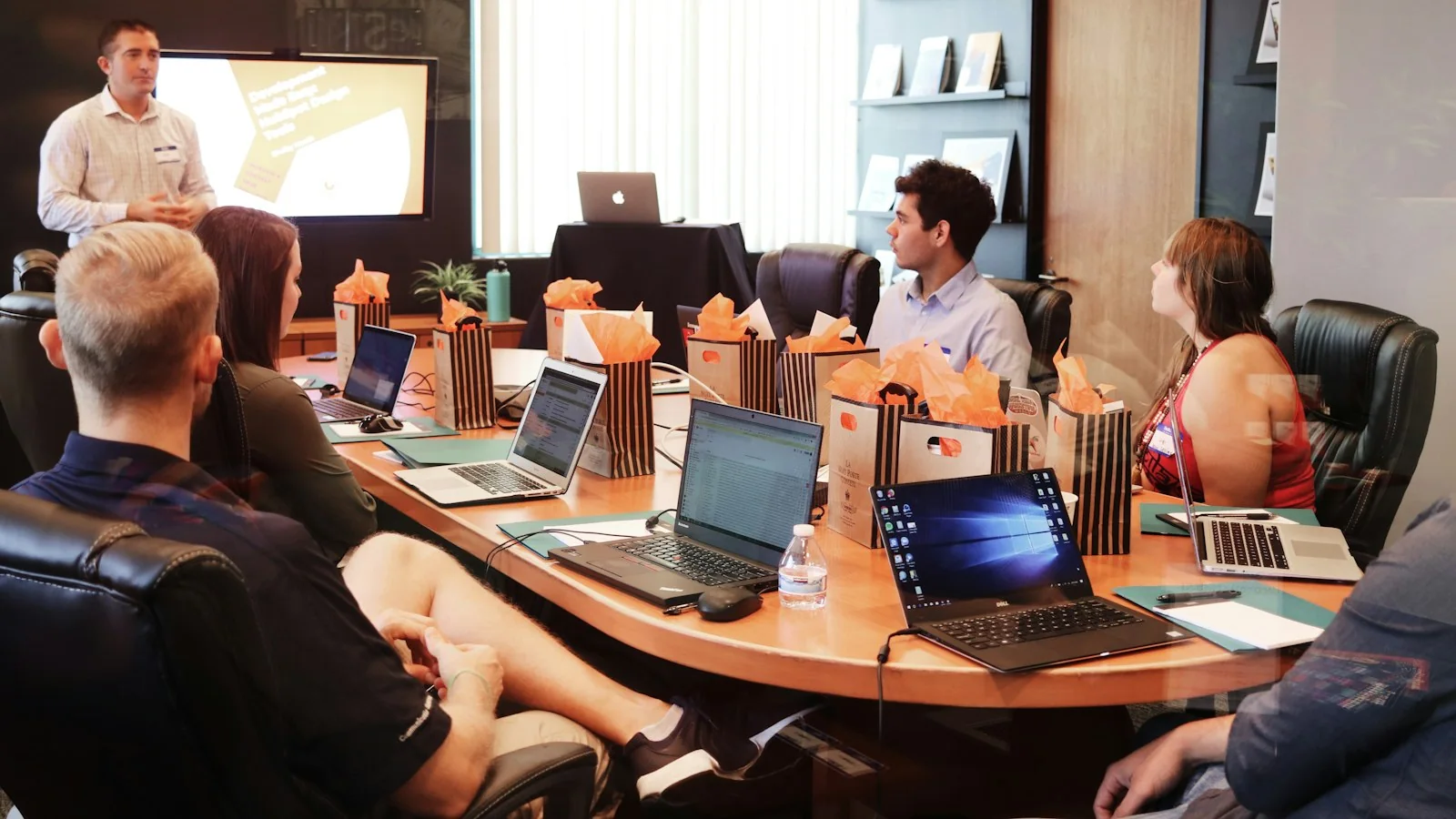
Presenter speaking to a team in a casual office meeting
Home / Creative Direction & Collaboration / Stakeholder alignment
Creative Direction & Collaboration · Stakeholder alignment

Stakeholder alignment: agree the problem before you design the answer

Most design projects that stall weren't aligned at the start. I help leadership, product, marketing, engineering and compliance agree the problem, the goals and how success will be judged - so feedback becomes decisions instead of debates.

Stakeholder mappingAlignment workshopsWritten briefsDecision rightsSuccess criteria

Why alignment comes first

A familiar pattern: a design project starts with a brief of a paragraph or two. The team works for weeks. At the review, a senior stakeholder sees the work for the first time and questions the direction - not the details, the direction. The team goes back to the start. Everyone is frustrated, and nobody did anything wrong. The project simply began without agreement on what it was for.

Stakeholder alignment is the work that prevents this. It makes the problem, the goals, the audiences, the constraints and the success criteria explicit - and gets the people who matter to agree them in writing before design starts.

The payoff is well documented. PMI's research found that of the US$135 million at risk for every US$1 billion spent on projects, US$75 million is on the line because of poor communication - and that organisations with highly effective communicators see 80% of projects meet original goals, compared with 52% for minimally effective ones.
Projects meeting their original goalsBy how effectively organisations communicate, PMI Pulse of the Profession, 2013
Highly effective communicators80%
Minimally effective communicators52%

Source: PMI, Communication: The Message Is Clear

View as table
Organisation typeProjects meeting original goals
Highly effective communicators80%
Minimally effective communicators52%
Is this you?

Signs alignment is missing

01

Late-stage direction changes

Reviews reopen questions everyone thought were settled.

02

Contradictory feedback

Different stakeholders ask for opposite things.

03

Nobody knows who decides

Feedback is collected but decisions don't happen.

04

The brief keeps growing

New requirements appear with every round.

05

Compliance or legal arrive late

Constraints surface after the design is done.

06

Success is undefined

The team can't say what "done" or "good" looks like.

Mapping the stakeholders

Alignment starts by knowing who is involved and how. I map stakeholders by their influence over the decision and their interest in the outcome, and agree how each will be involved.

GroupTypical membersHow to involve them
Decision-makersCEO, product or marketing head, sponsorAgree goals and criteria up front; involved at key decision points
Core contributorsProduct managers, lead engineers, marketing leadsRegular working sessions; co-own the brief
Specialists and gatekeepersCompliance, legal, security, accessibilityEarly input on constraints; review at defined checkpoints
InformedSales, support, regional teamsUpdates and chances to give input on specific questions

The single most important decision is often who has the final say on what. Agreeing decision rights early ends most circular debates later.

The alignment brief

The main output is a short written brief - usually two or three pages - that everyone involved has agreed:

  • Problem - what we're solving and why it matters now, with evidence.
  • Goals - what the work must achieve, ideally measurable.
  • Audiences - who the work is for, and what they need.
  • Scope - what's in, what's out, and what's deliberately left for later.
  • Constraints - technical, legal, compliance, budget and time.
  • Success criteria - how the work will be judged at each review.
  • Decision rights - who decides what, and when.

When feedback arrives later, it is measured against this brief. "I don't like the blue" becomes "does this meet the criterion of feeling calm and credible to procurement reviewers?" - a much more useful conversation.

The process

How I run alignment

  1. 01

    One-to-one conversations

    Short interviews with key stakeholders to understand goals, worries and assumptions.

  2. 02

    Stakeholder map

    Who's involved, how, and who decides what.

  3. 03

    Alignment workshop

    A focused session to agree the problem, goals, audiences and criteria, surfacing disagreements openly.

  4. 04

    Written brief

    Circulated, refined and signed off.

  5. 05

    Checkpoints

    Review points in the project where stakeholders see work against the brief.

  6. 06

    Decision log

    Decisions recorded as they're made, so they aren't reopened.

Alignment as the project runs

Alignment isn't a one-off. Throughout the project I keep it alive:

  • Show work early and often - rough work shared at checkpoints avoids big reveals.
  • Frame feedback - reviews start by restating the goals and criteria.
  • Log decisions - with the reasoning, so new stakeholders can catch up without reopening them.
  • Flag scope changes - new requests are weighed against the brief, not quietly absorbed.

On an AI enterprise brand project, this meant six phases - positioning, logo system, colour and type, website UX, applications and governance - each ending with a deliverable agreed before the next began. That structure kept a wide group of stakeholders aligned through a long project.

What you get

01

Stakeholder map

Who's involved, their interests and how they'll take part.

02

Alignment brief

Problem, goals, audiences, scope, constraints and criteria, signed off.

03

Decision rights

Who decides what, agreed in advance.

04

Workshop outputs

Documented agreements and open questions.

05

Checkpoint plan

When stakeholders see work and what they're asked to judge.

06

Decision log

A running record of decisions and their reasoning.

Frequently asked questions

How long does alignment take at the start of a project?

Typically a week or two - a handful of interviews, one workshop and a written brief. It usually saves far more time than it takes.

What if stakeholders genuinely disagree?

Surfacing the disagreement early is the point. The workshop makes trade-offs explicit and, where needed, escalates the decision to the person who owns it.

Can alignment be done remotely?

Yes. Interviews and workshops work well by video with good preparation. In-person sessions in Pune or Mumbai are possible too.

Who should attend the alignment workshop?

Decision-makers and core contributors. Specialists such as compliance or security can join for the constraints section if a full session isn't practical.

Does this only apply to big projects?

No. Even a small redesign benefits from a one-page brief with agreed goals, criteria and a named decision-maker.

Sources

Every statistic in this page links to its original publisher. Figures were checked against these sources on September 29, 2026.

  1. Communication: The Message Is Clear - PMI white paper, citing PMI Pulse of the Profession In-Depth Report: The Essential Role of Communications, 2013
Let's solve something

Stuck in feedback rounds that go in circles?

Let's align the people before we redesign the work. Book a 30-minute call.

Book a 30-min call ↗