
Hand-drawn growth chart on paper with a ruler and pen
Home / CRO & Experience Audits
Services · CRO & Experience Audits

Experience audits that tell you exactly what to fix first

A structured look at where users struggle and where conversions leak - combining heuristics, journey analysis, benchmarking and accessibility - delivered as a prioritised plan your team can act on.

UX auditsConversion reviewsHeuristic evaluationCompetitor benchmarkingJourney analysis

Why audit before you redesign

When a product or website underperforms, the instinct is to redesign. That instinct skips the step that decides whether the redesign will work: understanding exactly what is broken, why, and what matters most. Without it, teams often ship a better-looking version of the same problems.

An experience audit is a focused diagnostic. It combines several lenses - usability principles, analytics, user journeys, competitors and accessibility - to answer three questions:

  1. Where are users struggling or dropping off?
  2. Why is it happening?
  3. What should we fix first, given impact and effort?

The output is not a long list of generic best practices. It is a short, evidence-backed, prioritised plan, with each finding tied to a specific page, flow, persona or component.

What's included

The five parts of the work

Most audits combine several of these; a smaller fixed-scope audit can focus on one or two.

01

UX audits

A structured review of usability across your key journeys, with evidence and severity. Explore UX audits.

02

Conversion reviews

Funnel analysis and page-level review of where sign-ups, enquiries or purchases leak. Explore conversion reviews.

03

Heuristic evaluation

Expert review against established usability principles, fast and inexpensive. Explore heuristic evaluation.

04

Competitor benchmarking

How direct competitors, category leaders and adjacent industries handle the same journeys. Explore benchmarking.

05

Journey analysis & prioritised recommendations

End-to-end journeys mapped, with fixes ranked by impact and effort. Explore journey analysis.

06

Accessibility review

WCAG-informed checks folded into the audit so fixes are prioritised together. See accessibility reviews.

What the numbers say about friction

Small frictions add up to large losses. Baymard Institute's aggregation of 50 studies puts the average documented online shopping cart abandonment rate at 70.22%, and estimates that a large e-commerce site can gain a 35.26% increase in conversion rate through better checkout design alone. B2B journeys are longer and more collective: Forrester reports that 86% of B2B purchases stall during the buying process. And attention is short everywhere - users often leave pages within 10-20 seconds unless value is clear.

Why online shoppers abandon checkoutShare of surveyed US online shoppers who had abandoned a checkout, citing each reason
Extra costs too high (shipping, tax, fees)40%
Delivery was too slow20%
Didn't trust the site with card details19%
Had to create an account18%
Checkout too long or complicated17%
Website had errors or crashed17%

Source: Baymard Institute, cart abandonment research

View as table
ReasonShare of shoppers
Extra costs too high (shipping, tax, fees)40%
Delivery was too slow20%
Didn't trust the site with card details19%
Had to create an account18%
Checkout too long or complicated17%
Website had errors or crashed17%

The detail matters for B2B too: several of the top reasons - unexpected costs, forced account creation, complicated forms, errors and lack of trust - are design problems that apply equally to quote requests, trial sign-ups and application forms.

Audits for different kinds of product

Product typeWhat the audit focuses onTypical findings
SaaS and AI productsTrial activation, onboarding, key tasks, trust in AI outputSetup before value, unclear first action, missing sources and confidence cues
Healthcare platformsMulti-step workflows, status, accessibility, compliance-sensitive stepsCumulative friction, unclear status, repeated data entry
B2B catalogs and trade sitesNavigation, product pages, comparison, quote flowsDeep navigation, thin specifications, generic journeys for different buyers
Enterprise and infrastructure sitesCredibility, proof, evaluation support, contact routesTrack record not shown, inconsistent materials, unclear next steps
The process

How an audit runs

  1. 01

    Scope

    Agree goals, key journeys, user types and what data is available.

  2. 02

    Gather evidence

    Analytics, support tickets, recordings where permitted, and short stakeholder interviews.

  3. 03

    Review

    Heuristic and accessibility review of each journey, with screenshots and severity.

  4. 04

    Benchmark

    Competitors, category leaders and adjacent industries for the same journeys.

  5. 05

    Validate

    Quick user sessions on the biggest suspected issues where possible.

  6. 06

    Prioritise and present

    Findings ranked by impact and effort, with recommended fixes and a sequence.

What makes an audit useful

  • Specific, not generic. Every finding points to a page, flow or component, with evidence.
  • Prioritised. Impact and effort for every finding, so the team knows what to do on Monday.
  • Honest about uncertainty. Where evidence is thin, the recommendation is to test, not to assume.
  • Integrated. Accessibility, content and technical issues sit in the same list, not separate reports.
  • Short. A summary leaders can read in minutes, with detail behind it for the team.
Audit of a B2B hospitality equipment site's boxed layout
From the work

An audit that stopped the wrong redesign

A B2B hospitality equipment platform looked dated, and a visual refresh was the obvious answer. The audit found the real problems were structural.

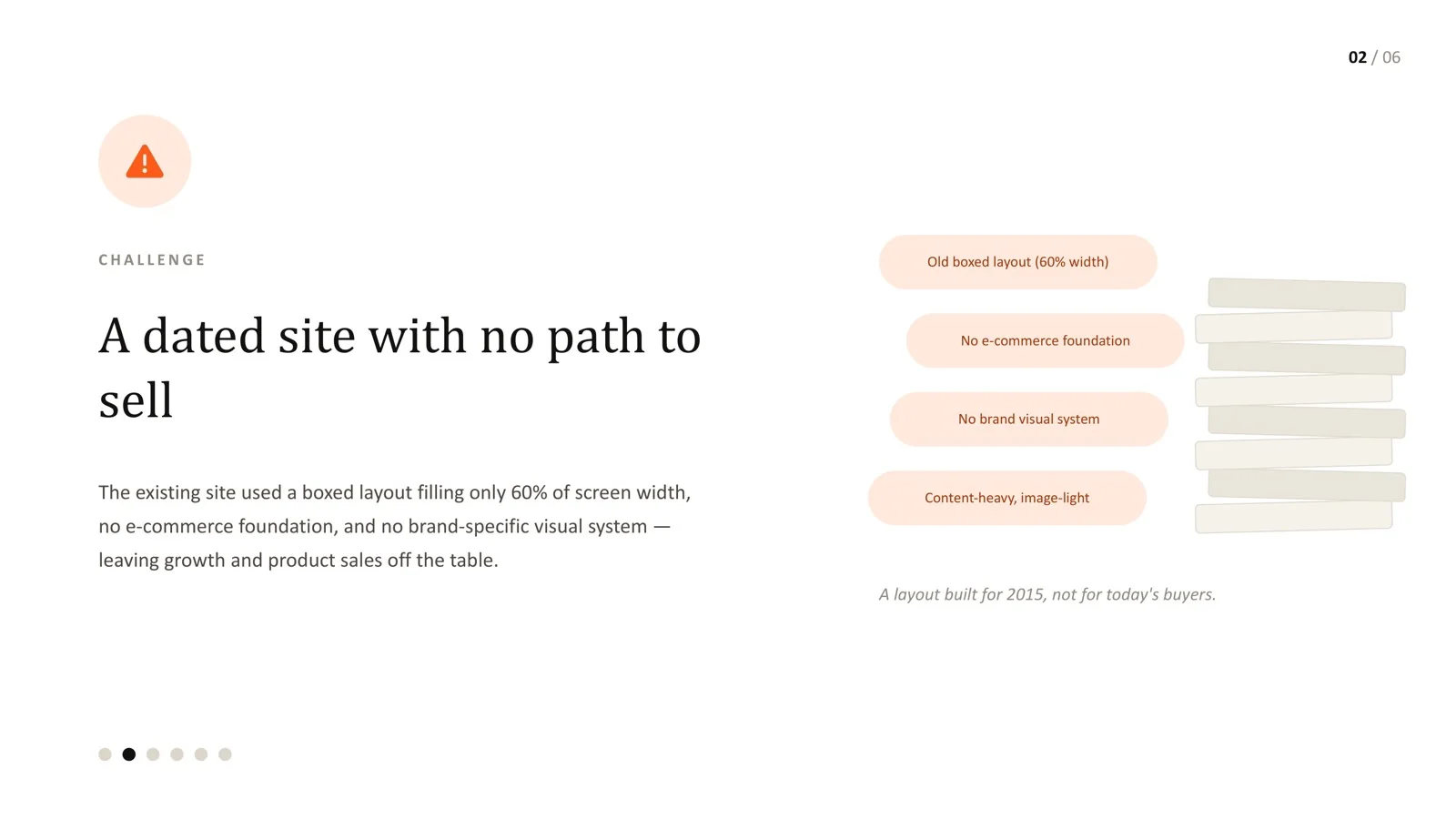
  • A boxed layout using only 60% of screen width, content-heavy and image-light, with no e-commerce foundation.
  • One navigation serving three very different buyer types.
  • Every recommendation tied to a page, persona or navigation decision - ready to build from.
Read the B2B hospitality case study →

Frequently asked questions

How long does an experience audit take?

A focused audit of a few key journeys typically takes a few weeks. The fixed-scope UX/CRO audit is designed for teams that want a defined scope and timeline.

Do you need access to our analytics?

It makes the audit sharper, but it isn't essential. Without analytics, heuristic review, benchmarking and a few user sessions still find most issues.

Will you tell us what to fix, or just what's wrong?

Both. Each finding comes with a recommended fix, an impact and effort rating and, where helpful, a sketch or example.

Can you help implement the fixes?

Yes. Many audits lead into design work on the highest-priority items; others are handed to your team with the prioritised plan.

Is an audit useful if we're planning a full redesign anyway?

Especially then. The audit tells the redesign what it must fix and what it can safely keep.

Sources

Every statistic in this page links to its original publisher. Figures were checked against these sources on September 29, 2026.

  1. Cart abandonment rate statistics - Baymard Institute
  2. The State Of Business Buying, 2024 - Forrester, 2024
  3. How Long Do Users Stay on Web Pages? - Jakob Nielsen, Nielsen Norman Group, 2011
Let's solve something

Not sure where your product is losing people?

Book a 30-minute call or send a message. I'll ask about your goals and data, and suggest the right audit scope.

Book a 30-min call ↗