Abstract fluid artwork in orange, blue and black
Home / Brand Strategy & Identity
Services · Brand Strategy & Identity

Brand strategy and identity that holds up everywhere your buyers look

I help B2B, SaaS, healthcare and infrastructure companies decide what their brand must communicate, then build an identity and a system that stays consistent from the pitch deck to the product.

Brand discoveryPositioningVisual identityCommunication directionBrand systems

What brand strategy and identity work actually covers

A brand is not a logo, and it is not a mood board. For the companies I work with - healthcare and AI SaaS platforms, B2B trade and equipment suppliers, infrastructure and industrial firms - a brand is the set of signals buyers use to decide whether you are credible before they have spoken to anyone. It lives in the website, but also in proposals, product screens, sales decks, documentation, email and the way your team describes what you do.

Brand strategy decides what those signals should say. Identity design decides how they look and sound. And a brand system makes sure they stay the same when fifty people across five teams are producing material every week.

I approach the three as one piece of work. In my experience the failures rarely come from a weak logo. They come from a gap between what the company is actually good at and what its brand communicates, or from an identity nobody can apply consistently once the launch is over.
What's included

The five parts of the work

Each can run on its own, but they are designed to connect. Most engagements start with discovery and positioning and move through to a governed system.

01

Brand discovery

Research and alignment before any design: stakeholder interviews, customer conversations, an audit of every touchpoint and a clear view of competitors. Explore brand discovery.

02

Positioning

A written, evidence-backed statement of who you serve, what you do better than the alternatives and why buyers should believe it. Explore positioning.

03

Visual identity

Logo system, colour roles, typography, imagery and iconography - each with a job, and each tested for accessibility. Explore visual identity.

04

Communication direction

Messaging hierarchy, tone of voice and proof points, so every writer sounds like the same credible company. Explore communication direction.

05

Brand systems

Guidelines, templates, components and governance so the identity survives day-to-day production. Explore brand systems.

06

Application and rollout

Website, product UI, documents and campaigns updated in a planned order, starting where buyers make decisions.

Why brand is a commercial decision in B2B

B2B buyers are careful, collective and quick to judge. Research on how people assess websites found they form a view of a page's visual appeal in about 50 milliseconds, and in Stanford's large credibility study, a site's "design look" was the most frequently cited credibility factor, mentioned in 46.1% of comments. Trust carries through to buying decisions: in Edelman's research, 81% of people said they must be able to trust a brand to do what is right.

There is also a longer-term case. At any moment most potential B2B buyers are not in the market - research by the Ehrenberg-Bass Institute with the LinkedIn B2B Institute puts the figure at around 95%. A brand's job is to be remembered as credible when the need arises. And companies that treat design as a discipline tend to outperform: McKinsey's five-year study of 300 listed companies found top-quartile design performers achieved 32 percentage points higher revenue growth than industry peers.

50 msfor people to form a view of a page's visual appealLindgaard et al., 2006
46.1%of credibility comments cited a site's design lookStanford, 2002
~95%of potential B2B buyers are out of the market at any momentEhrenberg-Bass / LinkedIn B2B Institute

Refresh, rebrand or brand system?

Not every company needs a new identity. Choosing the right scope is one of the first things discovery settles.

OptionWhen it fitsWhat changesWhat stays
Brand system onlyThe identity is sound but applied inconsistentlyRules, templates, components, governanceLogo, colours, name
Brand refreshThe identity feels dated or has practical problems, but carries equityRefined logo, updated palette and type, new systemName, core recognisable elements
RepositioningThe business has changed - new markets, offers or scalePositioning and messaging, then identity to matchName, often the symbol
Full rebrandA merger, a name problem or a fundamentally different businessName, identity, messaging, systemThe company's track record

In my experience, most established B2B companies need the first or second option. The biggest gains usually come from consistency and clearer positioning, not from a new logo.

The process

How an engagement runs

The same seven moves I use on every project, compressed for brand work. Every phase ends with a clear deliverable you approve before the next begins.

  1. 01

    Listen and align

    Conversations with leadership, sales and a few customers to understand the business, the buyers and what the brand must achieve.

  2. 02

    Discover

    An audit of every touchpoint, competitor and category benchmarking, and a synthesis of what buyers need to believe.

  3. 03

    Position

    A written positioning and messaging framework, agreed before visual work starts.

  4. 04

    Design the identity

    Logo system, colour roles, typography, imagery and voice, tested on real applications and for accessibility.

  5. 05

    Build the system

    Guidelines with measurable rules, templates, design components and a file library.

  6. 06

    Roll out

    Priority touchpoints first: website, proposals, product UI and sales material.

  7. 07

    Govern

    A named owner, a change process and periodic check-ins so the brand stays consistent.

Industries

Who this is for

01

Healthcare SaaS

Credentialing, clinical-operations and patient-facing platforms where trust, security and accessibility are part of the brand. See the healthcare case study.

02

AI and enterprise technology

Fast-shipping teams whose brand is fragmenting across product, marketing and sales. See the AI brand ecosystem.

03

B2B trade and equipment

Established suppliers whose reputation offline is stronger than their brand online. See the B2B hospitality redesign.

04

Infrastructure and industrial

Companies that need to look as disciplined and reliable as their delivery record. See the infrastructure brand system.

What makes the work hold up

Three principles run through every brand project I take on.

Positioning before pixels. Visual decisions are judged against a written positioning, not against taste. It is the fastest way to end circular feedback rounds.

Rules you can check. Guidelines use measurable rules - minimum logo sizes, approved colour pairings with contrast values, spacing scales - so anyone can tell whether something passes. On an infrastructure brand system, that meant specifications such as a 160px desktop minimum logo size and a 4-64px spacing scale.

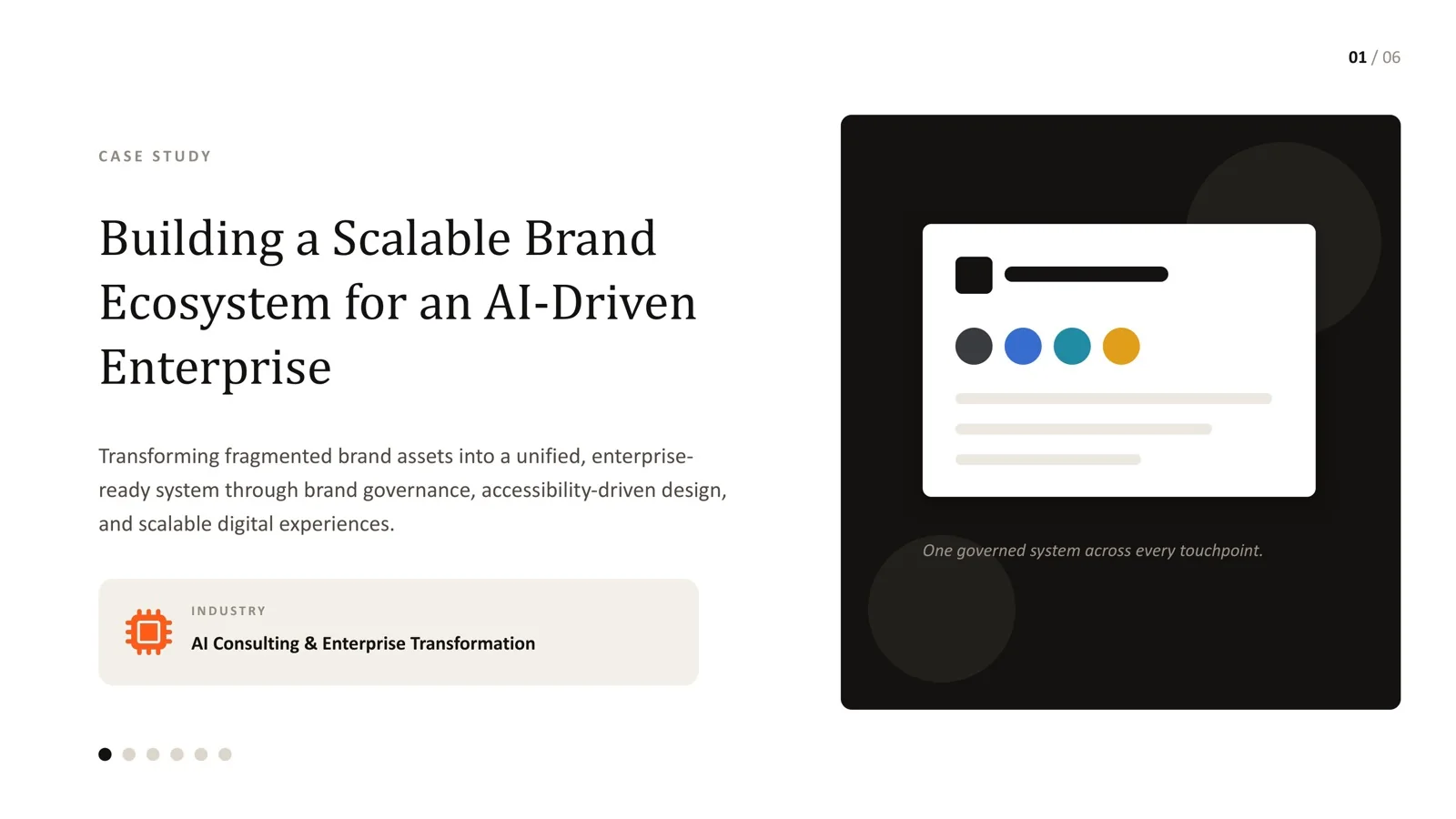
Accessibility built in. Colour pairings are tested against WCAG before approval. On an AI brand project, testing found an accent pairing already in use at 2.37:1 - far below the 4.5:1 minimum for body text - and the rebuilt system's primary pairing reached 17.26:1.

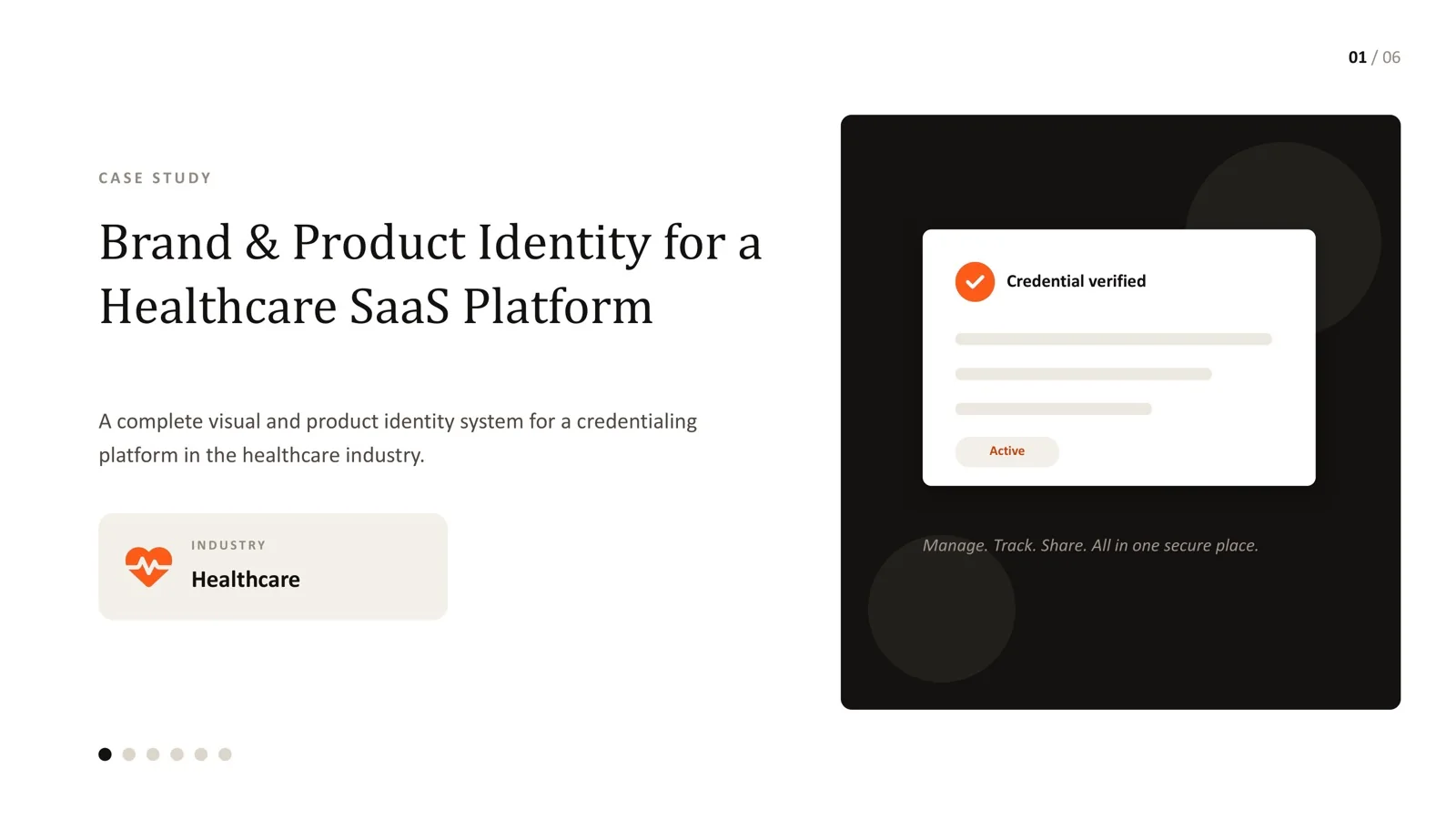
Healthcare credentialing platform brand overview
From the work

A brand and product identity system for a healthcare credentialing platform

A credentialing platform needed to communicate trust, security, simplicity and credibility across its product, website and marketing - while replacing a process full of manual paperwork, repeated data entry and unclear status.

  • Positioning and messaging defined before any visual work.
  • Visual identity, messaging and UI design built as one connected system.
  • Credential states such as "Active" and "Verified" communicated consistently in the product.
  • A system the team could extend to new channels without reinventing it.
Read the healthcare case study →

Frequently asked questions

How long does a brand strategy and identity project take?

It depends on scope and how quickly stakeholders can align. A focused positioning and system project is shorter than a full identity with rollout. Each phase has a clear deliverable, so timelines stay predictable.

Do you work with our existing marketing team or agency?

Yes. Many projects involve in-house marketers or agencies who will produce material after launch. I design the system and templates with them so it works in their tools.

Can you work with companies outside India?

Yes. I'm based in Pune and work remotely with teams in other regions. In-person workshops are possible in Pune and Mumbai.

What do we receive at the end?

The deliverables for each phase - such as the positioning framework, identity files, guidelines and templates - are listed in the proposal, and ownership and usage terms are agreed in the engagement contract before work starts.

Do we need a new logo?

Often not. Discovery tells us whether the existing identity carries equity worth keeping. Many companies get more value from positioning and a governed system than from a new mark.

Sources

Every statistic in this page links to its original publisher. Figures were checked against these sources on September 29, 2026.

  1. Attention web designers: You have 50 milliseconds to make a good first impression! - Lindgaard et al., Behaviour & Information Technology, 2006
  2. How Do People Evaluate a Web Site's Credibility? - Fogg et al., Stanford / Consumer WebWatch, 2002
  3. In Brands We Trust? - Edelman Trust Barometer Special Report, 2019
  4. The 95-5 Rule - LinkedIn B2B Institute with the Ehrenberg-Bass Institute
  5. The business value of design - McKinsey, 2018
Let's solve something

Brand that doesn't match the business you've built?

Book a 30-minute intro call or send a message. I'll ask about your buyers, your current brand and what's getting in the way - no pitch deck.

Book a 30-min call ↗